
AI Business Process Automation for Small & Mid-Size Businesses
Every growing SMB hits the same wall. Orders pile up faster than someone can key them into the system. Invoices sit in an inbox waiting for manual approval. Customer queries get answered a day late because the same three people are doing everything by hand. None of this is a people problem; it's a process problem, and it's one AI business process automation is built to solve. For small and mid-size businesses, this isn't about buying an off-the-shelf chatbot or a rules-based script that breaks the moment a workflow changes. It's about building automation that fits how your business actually runs, so your team spends less time on repetitive work and more time on the decisions that need a human.
بواسطة Anshul Pande · مهندس تسويق ونمو
What Business Process Automation with AI Actually Means
"Automation" gets used loosely, and it's worth being precise about it, because the two most common forms, rules-based automation (RPA) and AI-driven automation, solve very different problems.
Rules-based/RPA automation follows a fixed script: if X happens, do Y. It's useful for narrow, repetitive tasks, copying data from one spreadsheet to another, for instance, but it breaks the moment the input changes shape. A slightly different invoice format, an email worded differently than expected, a new field in a form, and the bot stalls or fails silently.
AI business process automation works differently. Instead of following a fixed script, it uses models that can read, reason, and make judgment calls within limits you set. It can look at an unstructured email, understand the request, pull the right data from three different systems, and take the next action or flag it for a person to review if it's outside its confidence threshold. It adapts to variation instead of breaking on it.
For an SMB, that distinction matters more than it does for a large enterprise. Smaller teams don't have the headcount to babysit brittle automations or manually patch workflows every time something changes. AI-driven automation is built to handle that variability on its own, which is exactly where rules-based tools fall short.

Where SMBs Get the Most Value
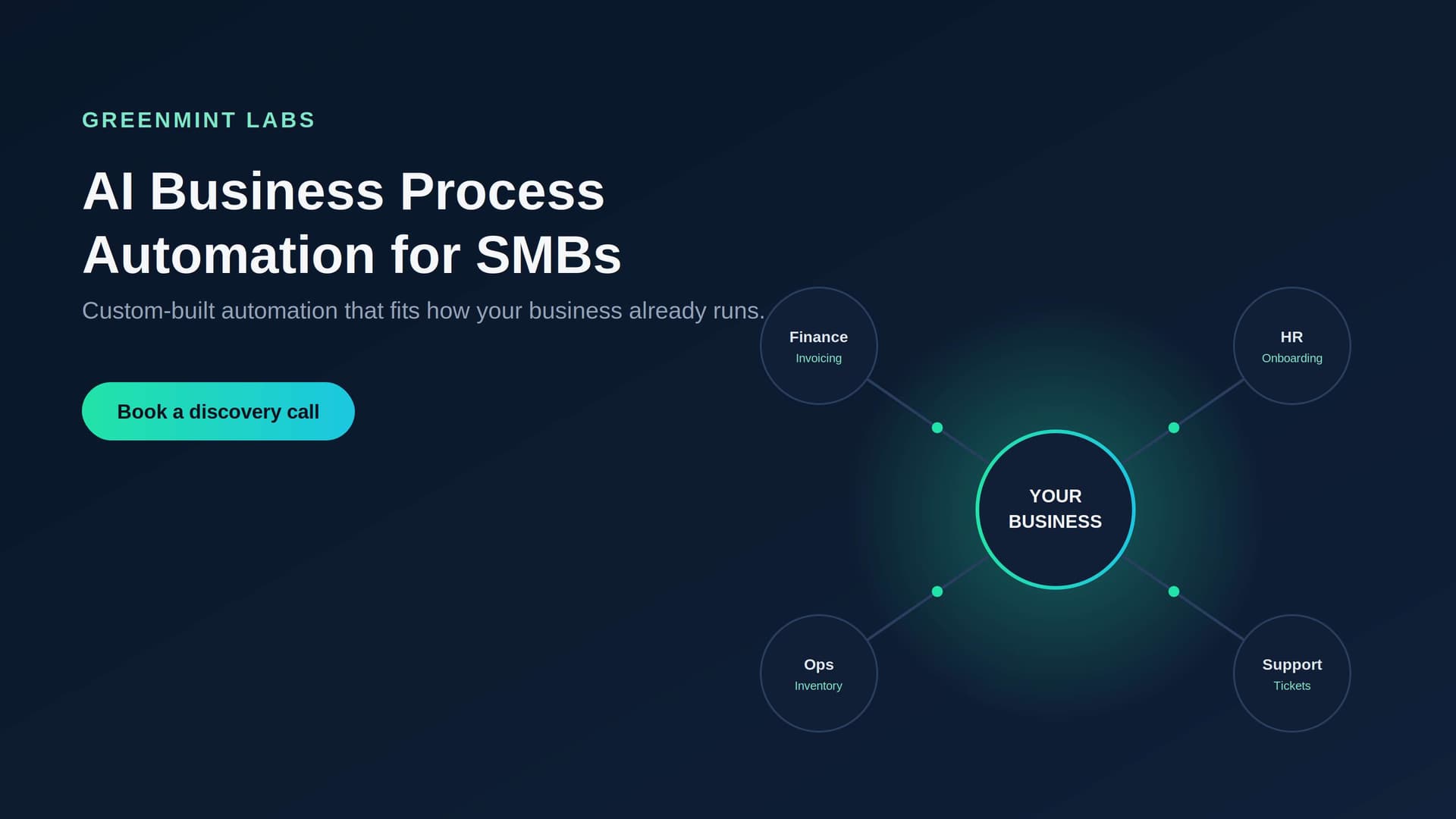
The businesses that benefit most from AI automation aren't necessarily the biggest ones; they're the ones where a handful of manual, repetitive processes are quietly eating hours every week. Finance teams keying in invoices and chasing approvals. HR teams manually screening resumes and scheduling interviews. Operations teams tracking inventory across spreadsheets and catching stockouts after they've already happened.
Left alone, these processes create delays and bottlenecks: decisions wait on someone's availability, errors compound because no one catches them until month-end, and the business scales linearly with headcount, because every new customer or order adds more manual work.
With the right automation layer in place, that changes. Approvals route themselves. Data moves between tools automatically. Exceptions get flagged in real time instead of surfacing weeks later in a reconciliation. The effect isn't just "less manual work"; it's that the business moves at machine speed on the processes that used to be the bottleneck, while your team focuses on the judgment calls that still need a human.
That's the real value for an SMB: not replacing people, but removing the drag that keeps a lean team from operating like a much larger one.

Custom vs. Bespoke AI Solutions: What "Custom-Built" Actually Means
"Custom AI solution" is one of the most overused phrases in this space, so it's worth being concrete about what it should mean in practice and what separates it from a generic tool with your logo on it.
A genuinely custom-built AI system starts with mapping how your business actually operates: which tools you already use, where data lives, where decisions get made, and where the real friction is. From there, the automation is designed around your existing systems your accounting software, your CRM, your inventory tool rather than asking your team to abandon what already works and learn a new platform.
That also means the system is scoped to fit your risk tolerance. A finance approval workflow might need a human sign-off above a certain dollar amount, while a routine data-entry task can run fully autonomously. Bespoke AI solutions are built with those guardrails from day one, not bolted on afterward.
The alternative is a generic automation product with light configuration, which usually works fine for the simplest workflows and starts to strain the moment your process has any real-world complexity: multiple approval chains, seasonal variation, exceptions that don't fit a template. Custom-built systems are designed to absorb that complexity instead of breaking on it, which is what makes them viable for the messier, more specific processes that generic tools tend to avoid.
4. Real Impact: What the Numbers Actually Show
Based on outcomes averaged across client deployments, businesses that implement AI-driven process automation with Greenmint Labs typically see operational cost reductions in the 60–80% range on the specific processes automated, along with a 99.9% task success rate across live automation runs.

A few things worth unpacking so those numbers read as evidence, not marketing copy:
- The cost reduction range is process-specific, not company-wide. It reflects the direct cost of running a particular workflow, say, invoice processing or lead qualification before and after automation, not a blanket claim about total operating expenses. The 60–80% range reflects the spread across different process types and client contexts, since a highly manual, high-volume process (like data entry) tends to see savings at the higher end, while more judgment-heavy processes see savings at the lower end.
- The success rate measures completed automation runs, not zero-touch autonomy. A 99.9% success rate means the automation executed the intended action correctly in 999 out of 1,000 runs, including cases where it correctly identified that a task needed human review and routed it accordingly, rather than guessing. That's part of the design, not a caveat: a system that knows when to defer to a person is safer than one that always acts.
- Both figures are averaged across live client deployments, not lab benchmarks or projected estimates. They'll vary by industry, process complexity, and how much of a workflow is genuinely automatable versus judgment-dependent, which is exactly why the discovery process starts with mapping your specific operation before any numbers get promised for your business.
The honest takeaway: these figures are a strong signal of what's achievable, not a guarantee for every process in every business. The right way to use them is as a benchmark to test your own use case against in a discovery conversation.
Frequently Asked Questions
How is AI business process automation different from RPA?
RPA follows fixed, rule-based scripts and breaks when inputs vary from the expected format. AI-driven automation can interpret unstructured inputs, make judgment calls within set limits, and adapt to variation which makes it more resilient for real-world business processes.
Is AI automation only useful for large enterprises?
No, SMBs are often where automation delivers the most relative impact, since a lean team feels the drag of manual, repetitive work more acutely than a larger organization with more headcount to absorb it.
Will automation replace my team?
The goal is to remove repetitive, low-judgment work so your team can focus on decisions that need human input, not to replace people. Custom deployments are built with human review built into the parts of a process that carry real risk or ambiguity.
How long does it take to see results?
This depends on the complexity of the process being automated, but most clients see measurable impact on the specific workflow automated within the first few weeks of deployment, since Greenmint scopes and ships in stages rather than one large rollout.
What does "custom-built" cost compared to off-the-shelf tools?
Custom AI solutions are scoped to your specific processes and systems, so pricing reflects the complexity of what's being automated rather than a flat subscription fee. A discovery call is the fastest way to get a real estimate for your business.
How do we get started?
Book a discovery call. Greenmint Labs will map your current operations, identify the processes with the highest automation value, and scope a custom solution no generic templates, no rip-and-replace.