
AI Agents for Finance & Accounting
Finance teams don't lose their week to hard problems. They lose it to volume: invoices to match, bank lines to reconcile, journal entries to draft, VAT summaries to assemble before someone can even start reviewing them. It's necessary work, and it's exactly the kind of work AI agents are best suited to take on not by replacing the accountant's judgment, but by doing the matching, drafting, and flagging that used to eat the hours before judgment could even happen. This is where "AI agent" stops being a buzzword and starts being a specific, useful thing: a system that can read a ledger, reconcile it against a bank feed, draft the entry, and hand it to a person for confirmation instead of a person doing all four steps by hand.
By Umar Farooque · AI System Engineer
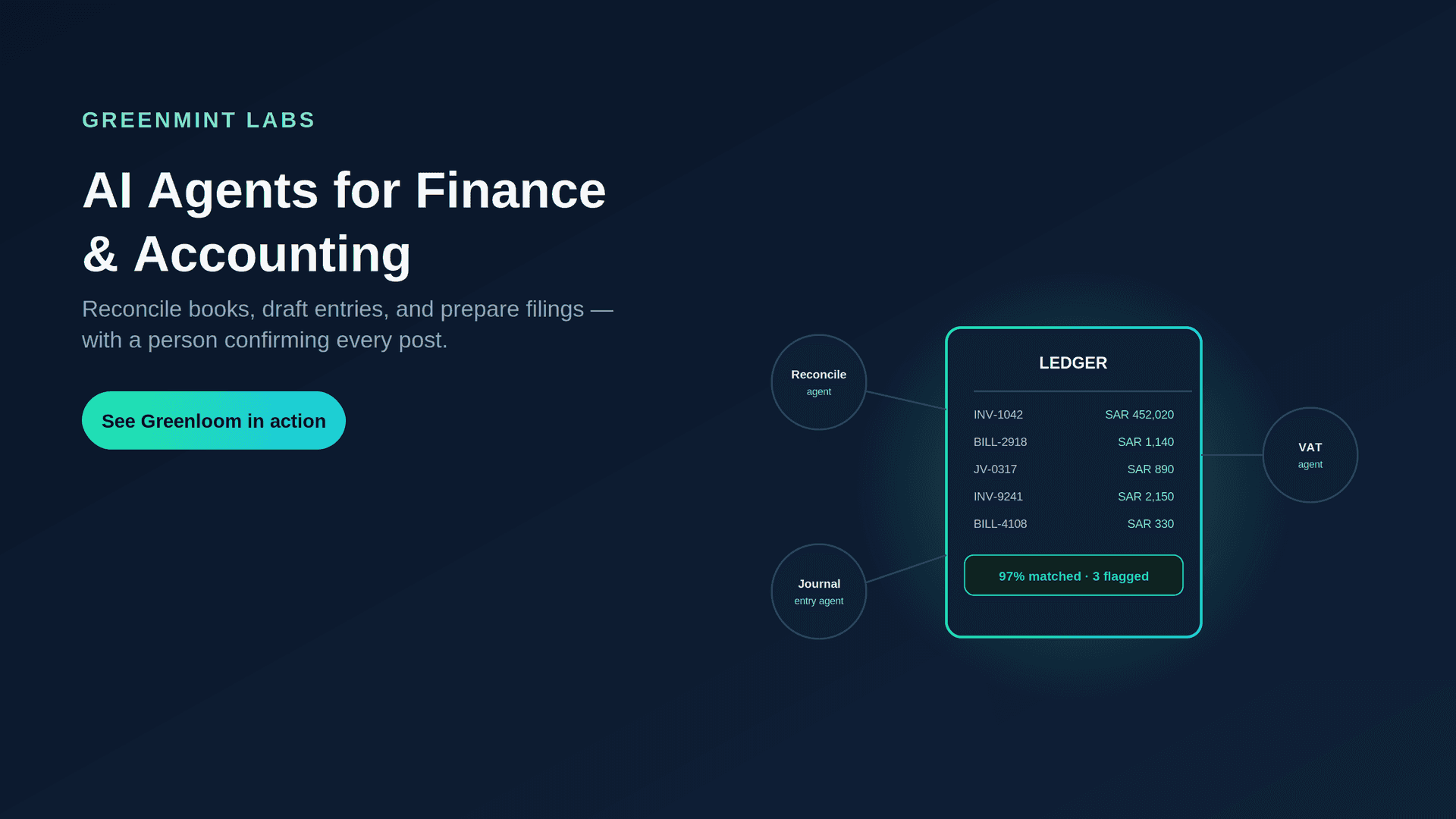
Where AI Agents Fit in a Finance Workflow
Three areas see the fastest, clearest impact.
- Bookkeeping. Instead of manually keying in bills, invoices, and vendor terms, an agent can read documents as they arrive, apply the correct ledger codes based on how your firm has coded similar transactions before, and prepare the entry for review. It doesn't guess it applies patterns your team has already confirmed.
- Reconciliation. Bank reconciliation is repetitive by nature: match transaction to ledger line, flag what doesn't match, repeat. An agent can run this continuously instead of once a month, catching mismatches while they're still easy to trace instead of during a stressful close.
- AP/AR. Chasing vendor invoices, tracking what's overdue, and flagging bills that fall outside agreed terms is exactly the kind of always-on monitoring a person shouldn't have to do manually. An agent can watch AP/AR aging in real time and surface exceptions: a bill that's suspiciously above the usual rate, an invoice sitting past 30 days before they become a month-end surprise.

The common thread: agents handle the matching, drafting, and flagging. A person still confirms anything that posts, approves anything above a threshold, and makes the calls that carry real judgment. That division of labor is what makes this different from either fully manual bookkeeping or a "fully automated" black box nobody trusts.
Case Study: Greenloom, Agentic AI for Finance Teams
The clearest way to show what this looks like in practice isn't a hypothetical; it's Greenloom, Greenmint Labs' own agentic-finance product, live today and already working inside real finance teams' ERPs.
Greenloom deploys six specialist agents reconciliation, journal entry, invoice & expense, VAT, Zakat & VAT, and audit into a single workspace connected directly to a business's ERP (Odoo, Zoho Books, or Tally). Rather than a chatbot bolted on top of accounting software, Greenloom reads the ledger, reconciles AP/AR and bank lines against it, and drafts journal entries and filing-ready VAT summaries in place, where the ledger already lives.

The design principle that matters most for trust: every write is confirmation-gated. Greenloom never posts a journal entry silently. Each draft shows a dry-run preview target ledger, line items, totals, and VAT treatment before a single riyal moves, and postings above a firm-set threshold always route to a person for sign-off. The reconciliation agent alone typically matches the large majority of transactions automatically and flags the rest for review, rather than forcing someone to reconcile a full ledger by hand.
Underneath that, Greenloom maintains institutional memory of vendor terms, posting conventions, chart-of-accounts mappings, and approval patterns a team has confirmed before, so each new run drafts the way a specific firm actually records things, not a generic template. That's the difference between an agent that has to be re-taught every month and one that gets more useful the longer it runs.
For a deeper look at how the reconciliation and journal-entry agents work end to end, see Greenloom's guides on bank reconciliation and journal entries & bookkeeping.
Beyond Off-the-Shelf Accounting Software
Accounting software like Tally, Zoho Books, or an ERP module is built to record what already happened. It's not built to reconcile itself, chase a vendor invoice, or notice that a bill just came in 8% above the agreed rate. That gap is exactly where a purpose-built agent layer goes further than the software most finance teams already run.

The difference shows up in a few concrete ways. Off-the-shelf software waits for someone to open it and do the work; an agent can run reconciliation nightly and have exceptions ready before anyone logs in.
Off-the-shelf software treats every entry the same; an agent that remembers a firm's posting conventions and vendor history can apply judgment a static rules engine can't. And critically, a well-built agent layer doesn't replace the accounting software or ask a team to migrate; it works inside the systems already in place, reading and writing through the same ERP a firm already trusts.
That's also where custom deployment matters more than a generic add-on. Every finance team's chart of accounts, approval thresholds, and VAT treatment differs. A custom-built agent layer, whether that's Greenloom for ERP-native finance teams or a bespoke deployment scoped to a specific operation, is designed around those specifics from day one, rather than asking the business to adapt to a one-size-fits-all tool.
Frequently Asked Questions
What can an AI agent actually do in finance and accounting?
It can reconcile bank and ledger lines, draft journal entries, monitor AP/AR aging, flag mismatches or anomalies, and prepare filing-ready VAT or Zakat summaries, all staged for a person's review and confirmation rather than posted automatically.
Will an AI agent post transactions without anyone checking?
Not in a well-designed deployment. The standard is confirmation-gated writes: every entry shows a dry-run preview before it posts, and anything above a set threshold routes to a person for sign-off.
Is this different from the automation features already in my accounting software?
Yes. Built-in automation in accounting software is typically rules-based and reactive; it waits for someone to run it. Agentic automation can run continuously, interpret unstructured inputs like invoices or emails, and apply judgment based on a firm's own history rather than a fixed rule.
What ERPs or accounting tools can this connect to?
It depends on the deployment. Greenloom, for example, works inside Odoo, Zoho Books, and Tally today. A custom deployment can be scoped to whatever ERP or accounting system a business already runs.
How is this different from hiring another bookkeeper?
An agent doesn't replace the judgment a bookkeeper or accountant brings; it removes the repetitive matching and drafting that eats their time, so the person spends their hours reviewing and deciding rather than data-entering.
How do we get started? See Greenloom in action for a live example of agentic finance automation, or book a discovery call with Greenmint Labs to scope a custom agent deployment around your own finance stack.
See Greenloom in action → · Book a discovery call →